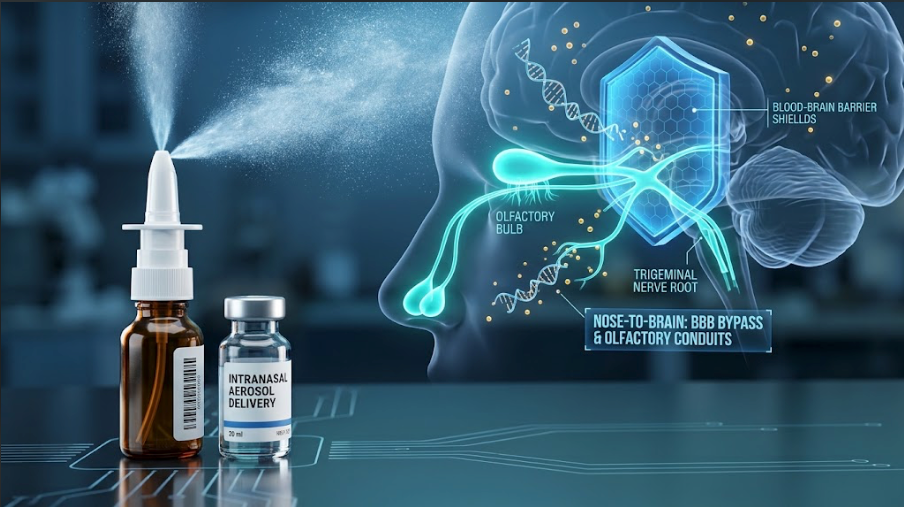
Nose-to-Brain Peptide Delivery: Mechanisms & Nasal Aerosols
Targeting the central nervous system (CNS) has always been difficult in pharmacology. Peptides are ideal therapeutic candidates because they provide high receptor selectivity and low toxicity. However, standard administration methods struggle to deliver peptides into brain tissue effectively.
In fact, therapeutic molecules face an evolutionary shield: the Blood-Brain Barrier (BBB). A published review in Pharmaceutics (PMC9502087) explores an effective alternative. Specifically, researchers are evaluating nose to brain peptide delivery using advanced nasal aerosols.
Below is an analysis of how this direct pathway functions. In addition, we examine why intranasal delivery solves common administration challenges.
Quick Summary: Nose-to-Brain Peptide Delivery at a Glance
Quick Answer: Nose-to-brain peptide delivery utilizes advanced nasal aerosols to bypass the blood-brain barrier (BBB) entirely. By depositing formulations in the upper nasal vault, compounds travel along the olfactory and trigeminal nerve pathways straight into cerebrospinal fluid, offering higher central nervous system concentrations, reduced peripheral side effects, and a non-invasive alternative to injections (evaluated extensively for nootropic peptides like Semax and Selank).
| Formulation Type | Key Advantages | Engineering & Handling Challenges |
|---|---|---|
| Liquid Aerosols & Sprays | Simple to formulate. In addition, liquid sprays use widely available pump hardware. | Prone to anterior runoff. Furthermore, liquid solutions have shorter shelf stability and need preservatives. |
| Dry Powder Inhalers (DPIs) | Superior stability. Powder avoids aqueous breakdown and adheres firmly to mucosal linings. | Requires precise particle engineering (10–50 μm) so particles do not enter the lungs. |
The Delivery Bottleneck: Why Standard Routes Fail
To understand the value of nasal delivery, consider the limitations of traditional administration:
- Oral Ingestion Fails Quickly: Swallowed peptides face rapid destruction from gastric acids. Digestive enzymes degrade the compounds immediately. Furthermore, hepatic first-pass metabolism eliminates most remaining active agents.
- Injections Cause Dilution: Injected peptides enter the bloodstream intact. However, systemic circulation rapidly dilutes the dose across five liters of blood. In addition, serum enzymes clear active molecules within minutes.
- The Blood-Brain Barrier Blocks Entry: Capillary cells in the brain are bound by tight junctions. This creates extreme electrical resistance. Consequently, the BBB rejects almost all large, water-soluble peptide molecules.
Historically, crossing this barrier required invasive hospital procedures. These methods included direct brain infusions and chemical disruption. However, these techniques are neither safe nor practical for ongoing research protocols (explore broader administration routes in our SubQ vs. IM vs. Nasal Delivery Guide).
The Biological Pathway: Olfactory and Trigeminal Nerves
Nose to brain peptide delivery targets the upper nasal vault. This area is the only direct connection between the brain and the external environment. Therefore, aerosolized compounds bypass the bloodstream by traveling along two neural paths:
1. The Olfactory Pathway (The Direct Route)
The olfactory neuroepithelium sits beneath the cribriform plate of the ethmoid bone. Olfactory receptor neurons extend directly into the nasal mucus layer. Meanwhile, their axons project upward into the olfactory bulb. As a result, peptides move along perineural channels into the cerebrospinal fluid within minutes.
2. The Trigeminal Nerve Pathway (The Deep Route)
The trigeminal nerve innervates both the respiratory and olfactory mucosa. Axons from this system branch across the nasal cavity. Consequently, fluid flow along these nerve fibers carries particles toward the brainstem and deeper brain tissue.
Why Choose Nasal Sprays for Specific Peptides?
Administration routes directly dictate biological distribution. Because of this, nasal aerosols offer distinct advantages for neurological research:
1. Higher Brain Concentrations With Lower Doses
Injectable peptides must overcome significant barrier resistance. In contrast, nasal delivery deposits molecules right at cranial nerve junctions. Because the distribution remains focused on the CNS, smaller doses produce equivalent biological activity.
2. Reduced Peripheral Side Effects
Receptors for peptides often exist throughout the entire body. If a cognitive compound enters systemic circulation, it can trigger off-target effects in organs like the heart or kidneys. Nasal delivery limits systemic exposure. Therefore, it protects peripheral tissues from unnecessary compound load.
3. Avoidance of Liver Breakdown
Nasal mucosal absorption avoids the digestive tract entirely. Similarly, it bypasses the portal vein. Thus, liver enzymes never degrade the molecular structure of the peptide.
4. Superior Protocol Compliance
Injections require sterile needles, alcohol swabs, and sharps disposal containers. Over time, daily injections create needle fatigue and skin irritation. Conversely, nasal sprays provide a non-invasive format. This simple routine helps users maintain protocol consistency without friction.
Liquid Sprays vs. Dry Powder Inhalers (DPIs)
Reaching the upper nasal vault requires proper formulation engineering. The review compares the two primary aerosol delivery options:
Hardware Considerations: Standard consumer spray bottles produce coarse droplets. Most of this fluid lands in the anterior nose. Cilia then clear the liquid toward the throat in under twenty minutes. Therefore, specialized narrow-angle actuators or breath-powered devices are essential to reach the upper olfactory cleft.
Summary: Choosing the Right Route
- Use Injections When: Your targets are systemic (e.g., choose injections for muscle repair with BPC-157 and TB-500, systemic fat loss, or peripheral metabolic pathways).
- Use Nasal Delivery When: Your goals are neurological or cognitive (e.g., choose sprays for sleep regulation with DSIP, neuroprotection, or central brain signaling).
Nose-to-brain peptide delivery represents a transformative approach for bypassing the blood-brain barrier without invasive procedures. By utilizing the olfactory and trigeminal nerve pathways, researchers can achieve high central nervous system concentrations using minimal dosing volumes. For more insights into cognitive research compounds, review our Nootropic Peptides Guide.
← View all peptide guides, research & protocols in our Blog Archive