
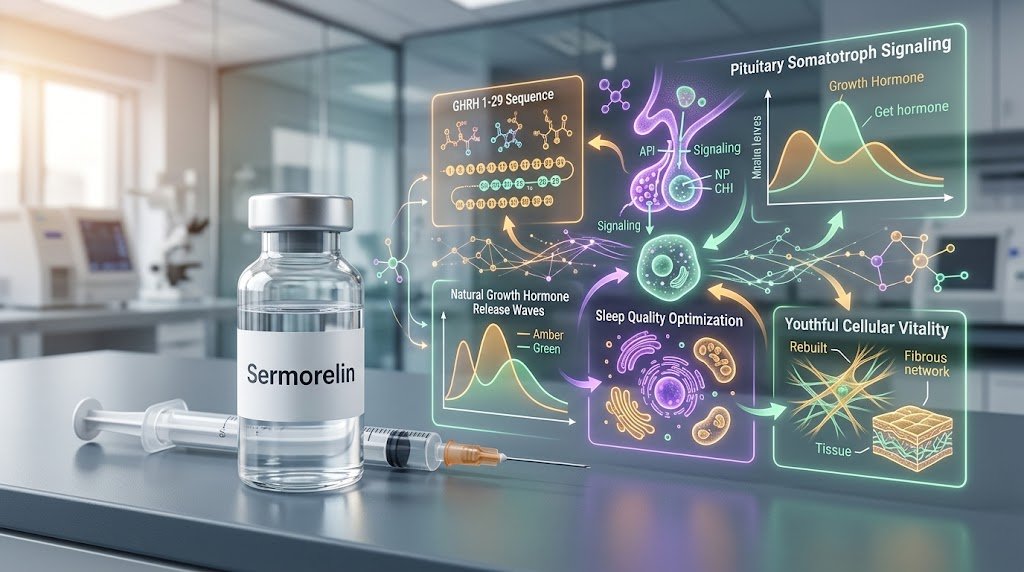
Sermorelin GHRH Protocols: Mechanisms, Dosing & Evidence
Within neuroendocrinology and pituitary research, Sermorelin represents the foundational archetype of bioidentical growth hormone stimulation. By isolating the shortest functional fragment of human growth hormone-releasing hormone, it stimulates the pituitary gland to preserve natural, pulsatile hormone secretion.
Online wellness clinics often market Sermorelin as a direct fountain of youth, promising effortless fat loss, skin tightening, and deep sleep restoration. However, disciplined scientific evaluation requires researchers to examine its exact 29-amino-acid structure, its upstream GHRH receptor signaling cascade, and the key pharmacokinetic differences that distinguish it from newer analogues like CJC-1295.
Quick Summary: What Is Sermorelin at a Glance?
Quick Answer: Sermorelin (GRF 1-29 NH2) is a synthetic 29-amino-acid peptide that represents the complete functional amino-terminal sequence of native hypothalamic Growth Hormone-Releasing Hormone (GHRH). It binds GHRH receptors on pituitary somatotrophs to stimulate cyclic AMP (cAMP) and intracellular calcium influx, triggering natural, pulsatile growth hormone and IGF-1 secretion while remaining subject to somatostatin negative feedback.
| Parameter | Sermorelin (Native GRF 1-29) | CJC-1295 No DAC (Mod GRF 1-29) |
|---|---|---|
| Sequence Homology | Exact 29-amino-acid sequence of native human GHRH | Synthetic tetrasubstituted analogue (resists DPP-4) |
| Elimination Half-Life | Roughly 10 to 12 minutes (rapid serum clearance) | Approximately 30 minutes |
| Secretion Pattern | Sharp, physiological growth hormone spikes | Extended, amplified growth hormone pulses |
| Typical Evaluation Dose | 200–500 mcg per administration (fasted state) | 100 mcg per administration (often paired with Ipamorelin) |
| Direct Research Supply | Paired secretagogues available via CJC-1295 / Ipamorelin (10mg) | |
What Is Sermorelin?
Sermorelin (also designated as GRF 1-29 NH2) is a synthetic 29-amino-acid peptide with an amidated C-terminus and a molecular weight of approximately 3,358 Daltons.
Endogenous growth hormone-releasing hormone (GHRH) produced by the hypothalamus consists of a 44-amino-acid chain. In the late 20th century, researchers identified that the biological activity and receptor affinity of full-length GHRH reside entirely within its first 29 N-terminal amino acids. The remaining 15 residues provide structural protection but contribute nothing to receptor binding.
Chemists synthesized this functional 1-29 fragment as Sermorelin. The peptide historically gained FDA approval as a clinical diagnostic agent to evaluate pituitary function in children exhibiting growth hormone deficiency. Although pharmaceutical manufacturers later discontinued the commercial branded product Geref for commercial reasons, Sermorelin remains a primary research standard for evaluating targeted somatotrophic restoration.
Mechanisms of Action: How Sermorelin Stimulates the Pituitary
Sermorelin does not directly mimic human growth hormone. Instead, it operates upstream at the level of the anterior pituitary:
1. GHRH Receptor Binding & Adenylyl Cyclase Activation
Sermorelin binds selectively to GHRH receptors on anterior pituitary somatotrophs. This binding event activates Gs-protein alpha subunits, stimulating adenylyl cyclase to convert adenosine triphosphate (ATP) into intracellular cyclic adenosine monophosphate (cAMP).
2. Protein Kinase A (PKA) Activation & Calcium Influx
Accumulating cAMP activates protein kinase A (PKA). PKA then phosphorylates voltage-dependent L-type calcium channels, driving an influx of extracellular calcium ($Ca^{2+}$) into somatotroph cells. This calcium wave triggers the rapid exocytosis of pre-formed growth hormone secretory granules into circulation. Concurrently, PKA phosphorylates the transcription factor CREB, turning on growth hormone gene transcription to restock the pituitary reservoir.
3. Downstream IGF-1 Elevation & Hepatic Clearance
Circulating growth hormone pulses travel to the liver, where they bind GH receptors to trigger synthesis and secretion of Insulin-Like Growth Factor 1 (IGF-1) and its carrier protein IGFBP-3. IGF-1 mediates the anabolic, cellular regenerative, and protein synthesis processes observed throughout peripheral target tissues.
4. Preservation of the Somatostatin Negative Feedback Loop
The critical pharmacological safety feature of Sermorelin lies in its physiological regulation. Unlike exogenous recombinant human growth hormone (rhGH), Sermorelin cannot override endogenous feedback brakes. When circulating GH and IGF-1 levels rise, the hypothalamus releases somatostatin (growth hormone-inhibiting hormone). Somatostatin binds to somatotroph receptors, activating Gi-protein pathways that shut down adenylyl cyclase and prevent excessive, runaway hormone release. This mechanism prevents pituitary desensitization and protects against acromegalic side effects.
Sermorelin vs. CJC-1295: Key Pharmacokinetic Differences
While Sermorelin and CJC-1295 both target GHRH receptors, their chemical modifications create distinct biological timelines:
- Sermorelin (Native GRF 1-29): Retains the exact native amino acid sequence of the first 29 residues of human GHRH. Because it has no synthetic protection against dipeptidyl peptidase-4 (DPP-4), serum enzymes cleave it rapidly, giving it a short biological half-life of roughly 10 to 12 minutes. This brief clearance mirrors natural, physiological GH spikes.
- CJC-1295 (Mod GRF 1-29): Incorporates four specific D-amino acid substitutions (at positions 2, 8, 15, and 27) that shield it from DPP-4 cleavage, extending its elimination half-life to approximately 30 minutes. Learn more in our CJC-1295 and Ipamorelin Guide.
- CJC-1295 With DAC: Possesses a maleimidopropionic acid linker that bonds covalently to serum albumin, extending its biological half-life to 6–8 days and producing continuous elevation rather than discrete pulses.
Documented Laboratory Research & Dosing Protocols
Within published endocrinology trials, animal models, and investigative research, protocols apply the following experimental parameters. Syringe tick marks can be calculated using our free Peptide Calculator, while cycle timelines are organized in the Protocol Tracker Tool.
| Protocol Parameter | Single Evening Pulse Protocol | Multi-Pulse Regenerative Protocol |
|---|---|---|
| Experimental Focus | Circadian alignment, slow-wave sleep pulses, baseline IGF-1 restoration | Accelerated tissue recovery, metabolic rate studies, somatotroph responsiveness |
| Documented Dosing | 200–500 mcg per administration | 200–300 mcg administered 2–3 times daily |
| Administration Route | Subcutaneous (Sub-Q) injection | Subcutaneous (Sub-Q) injection |
| Timing Window | Strictly fasted: 30–60 minutes before sleep | Fasted: morning upon waking, post-exercise, and before sleep |
| Cycle Architecture | 12–16 weeks continuous evaluation (see our Peptide Cycle Timing Guide) | 8–12 weeks on / 4 weeks washout |
| Screening Panels | Serum IGF-1, IGFBP-3, fasting glucose, thyroid panel (TSH, free T3/T4) | Comprehensive metabolic panel (CMP), HbA1c, fasting insulin |
The Fasted State Requirement: Avoiding Somatostatin Interference
Administering Sermorelin requires strict attention to metabolic context. Ambient insulin and circulating free fatty acids act as direct somatotroph suppressors:
- Glucose & Insulin Spikes: Ingesting carbohydrates triggers insulin release, which prompts the hypothalamus to secrete somatostatin. Elevated somatostatin shuts down adenylyl cyclase, completely blunting Sermorelin's ability to trigger a GH pulse.
- Elevated Lipids: High circulating free fatty acids similarly dampen somatotroph responsiveness.
To achieve reliable experimental endpoints, protocols require a fasted window of at least two to three hours prior to subcutaneous injection, followed by 30 minutes of continued fasting before introducing nutrients.
Synergistic Research Pairings
Researchers frequently combine Sermorelin with complementary secretagogues or regenerative peptides:
- Ipamorelin / GHRPs: Scientists co-evaluate Sermorelin with selective ghrelin agonists like Ipamorelin. While Sermorelin drives cAMP signaling, Ipamorelin promotes calcium influx and blocks somatostatin, triggering a synergistic growth hormone release far larger than either peptide yields alone. Explore this synergy in our Ipamorelin Synergy Guide.
- BPC-157: Investigators study musculoskeletal repair by pairing Sermorelin with BPC-157 to analyze whether elevated systemic IGF-1 accelerates localized angiogenic recovery.
- TB-500: Research teams combine GHRH signaling with TB-500 to observe concurrent cellular actin upregulation alongside pulsatile growth factor production.
- AOD-9604: In metabolic studies, teams evaluate Sermorelin alongside AOD-9604 Peptide (or view AOD-9604 5mg) to analyze how systemic GH elevation interacts with isolated beta-3 adipocyte lipolysis.
- Tesamorelin: Evaluated alongside third-generation GHRH analogues in our Tesamorelin Research Guide to study targeted visceral adiposity clearance.
Laboratory Handling, Reconstitution & Storage Standards
Because Sermorelin is an unshielded 29-amino-acid peptide, it requires careful handling and cold-chain protection to maintain its tertiary structure (detailed step-by-step in our Beginner's Guide to Peptides):
- Diluent Selection: Reconstitute lyophilized Sermorelin using sterile, pharmaceutical-grade Pfizer Hospira Bacteriostatic Water containing 0.9% benzyl alcohol to prevent microbial contamination across multi-dose research protocols. Alternatively, use 0.9% Sterile Bacteriostatic Saline for cell-culture assays requiring strict isotonicity.
- Reconstitution Protocol: Use a sterile EasyTouch 31G Syringe to let the diluent trickle gently down the inside glass wall of the vial. Never spray liquid directly onto the lyophilized powder cake. Avoid vigorous shaking or vortexing; roll the vial slowly between your palms until the solution clears completely.
- Cold-Chain Storage: Store dry lyophilized vials at -20°C for long-term molecular preservation. Maintain reconstituted liquid solutions between 2°C and 8°C (36°F to 46°F) inside a secure, light-shielded Peptide Vial Case or insulated Compact Travel Case to protect against mechanical vibration and light degradation.
Sermorelin remains a gold-standard compound for evaluating natural growth hormone restoration. By providing the essential 29-amino-acid core of human GHRH, it stimulates physiological pituitary pulses without overwhelming the body's somatostatin negative feedback system. Following disciplined fasted administration windows, tracking baseline IGF-1 markers, and maintaining proper laboratory storage will ensure accurate, repeatable research outcomes.
← View all peptide guides, research & protocols in our Blog Archive


One comment