
Retatrutide Guide: GIP/GLP-1/Glucagon Action, Dosing & Trial Evidence
In metabolic research, scientists view Retatrutide as the frontier of multi-receptor incretin therapy. This single peptide molecule co-activates three distinct metabolic receptors to produce unprecedented weight loss and glycemic control in clinical trials.
Online fitness and biohacking forums frequently label Retatrutide the ultimate fat-loss compound, claiming it completely overshadows earlier peptides like Semaglutide and Tirzepatide. However, scientific rigor demands that investigators look past marketing buzz. Evaluating Retatrutide requires examining its biochemistry as a triple receptor agonist, the distinct role of its glucagon component, and the real physiological data emerging from ongoing human trials.
Quick Summary: What Is Retatrutide at a Glance?
Quick Answer: Retatrutide (LY3437943) is an investigational 39-amino-acid synthetic peptide engineered as a unimolecular triple receptor agonist targeting GIP, GLP-1, and Glucagon receptors. By combining central appetite suppression with glucagon-mediated hepatic lipid clearance and resting energy expenditure, it produced up to 24.2% mean body weight reduction in Phase 2 clinical trials.
| Receptor Target | Primary Biological Mechanism | Metabolic Research Impact |
|---|---|---|
| GIP Receptor (GIPR) | Subcutaneous lipid buffering and insulin sensitizing | Mitigates nausea and directs energy partition away from visceral fat |
| GLP-1 Receptor (GLP-1R) | Hypothalamic satiety signaling and delayed gastric transit | Suppresses central food noise, curbs appetite, and stabilizes glucose |
| Glucagon Receptor (GCGR) | Hepatic lipid oxidation and thermogenic caloric expenditure | Elevates resting caloric burn and clears intrahepatic steatosis |
| Direct Research Supply | HPLC-verified research vials available via Retatrutide (10mg / 20mg) | |
What Is Retatrutide?
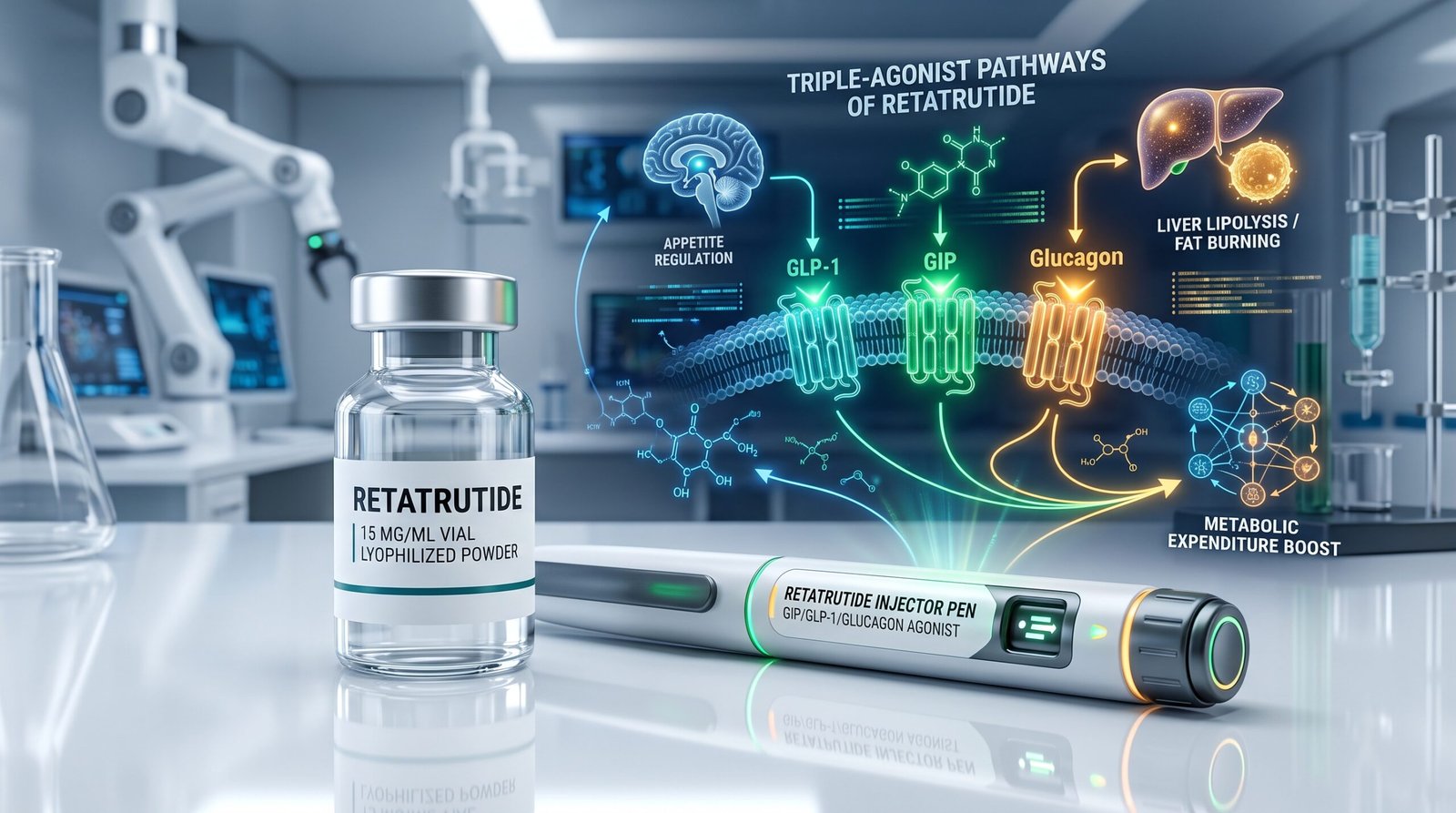
Retatrutide (development code LY3437943) is an engineered 39-amino-acid synthetic peptide. Eli Lilly designed the compound to act as a unimolecular triple agonist targeting three related metabolic receptors:
- GIPR: Glucose-dependent insulinotropic polypeptide receptor
- GLP-1R: Glucagon-like peptide-1 receptor
- GCGR: Glucagon receptor
Chemically, Retatrutide builds upon a modified GIP peptide backbone. The molecular design incorporates non-coded amino acids (such as alpha-aminoisobutyric acid) and attaches a C20 fatty diacid side chain via a specialized linker. This fatty acid modification allows the peptide to bind albumin in the bloodstream, extending its elimination half-life to approximately six days. This pharmacokinetic profile supports a steady once-weekly administration schedule in research protocols.
Mechanisms of Action: The Triple Agonist Dynamic
While first-generation agents activate only GLP-1 and second-generation agents target both GLP-1 and GIP, Retatrutide adds glucagon receptor activation to achieve distinct, multi-organ synergy:
1. GIP Receptor Agonism (Sensitization & Lipid Storage)
Retatrutide demonstrates its highest receptor potency at the GIP receptor. In adipose tissue and the pancreas, GIP signaling improves insulin sensitivity, enhances nutrient uptake into subcutaneous fat depots rather than visceral storage, and buffers against the gastrointestinal nausea typically triggered by intense GLP-1 activation.
2. GLP-1 Receptor Agonism (Appetite Suppression & Glycemic Control)
GLP-1 receptor activation slows gastric emptying and engages appetite-regulating centers in the hypothalamus and hindbrain. This signaling reduces hunger sensations, curbs food cravings, and prompts glucose-dependent insulin secretion from pancreatic beta cells while limiting inappropriate post-meal glucagon release.
3. Glucagon Receptor Agonism (Thermogenesis & Hepatic Lipid Clearance)
The addition of glucagon receptor (GCGR) agonism represents Retatrutide's defining technological evolution. Unlike GLP-1, which primarily curbs energy intake, glucagon signaling acts directly on the liver and brown adipose tissue to increase energy expenditure. It accelerates hepatic fat oxidation, clears intrahepatic lipid deposits, and stimulates mitochondrial thermogenesis, burning calories even during periods of caloric restriction.
What Does the Clinical Research Actually Show?
Unlike early-stage peptides supported solely by rodent trials, Retatrutide boasts high-quality, peer-reviewed human clinical data published in the New England Journal of Medicine and The Lancet.
Phase 2 Clinical Trial Milestones
In a landmark 48-week Phase 2 randomized, double-blind trial involving adults with obesity, participants receiving the highest dose (12 mg weekly) achieved an average body weight reduction of up to 24.2%. This efficacy surpassed the 48-week outcomes previously observed in clinical trials for Semaglutide (~15%) and Tirzepatide (~21%).
Non-Alcoholic Fatty Liver Disease (MASLD/MASH) Clearance
The glucagon mechanism demonstrated remarkable efficacy in liver health substudies. Over 85% of subjects receiving higher doses of Retatrutide achieved complete normalization of liver fat (liver fat fraction below 5%), clearing significant hepatic steatosis within 24 to 48 weeks.
Documented Physiological Effects & Monitoring Needs
Because glucagon and GLP-1 receptors interact with autonomic nervous pathways, researchers documented a dose-dependent increase in resting heart rate (peaking between 24 and 36 weeks before declining), along with expected incretin-related gastrointestinal events (nausea, diarrhea, and constipation). Investigators track cardiac metrics alongside digestive tolerance closely throughout escalating protocols. For specialized low-dose titration concepts, see our guide on GLP-1 microdosing schedules.
Documented Research Titration & Dosing Protocols
Clinical trial literature and investigative research protocols emphasize slow, stepwise dose escalation to minimize acute gastrointestinal and cardiac side effects. In practice, community research models emphasize a symptom-gated ramp, stepping up only when the current dose is completely nausea-free. Investigators map volumetric increments with our free Peptide Calculator and manage schedule intervals using the Protocol Tracker Tool.
| Protocol Stage | Weekly Subcutaneous Dose | Evaluation Window | Primary Research Focus |
|---|---|---|---|
| Initiation / Baseline | 2 mg once weekly (or 0.5–1.0 mg micro-start) | Weeks 1–4 | Receptor habituation, gastric adaptation, and tolerability baseline |
| Intermediate Titration | 4 mg once weekly | Weeks 5–8 | Early appetite suppression and baseline glycemic monitoring |
| Therapeutic Step 1 | 8 mg once weekly | Weeks 9–12 | Sustained lipolysis, energy expenditure markers, and hepatic lipid shifts |
| Maximum Evaluation | 9–12 mg once weekly | Weeks 13+ | Maximal triple-pathway metabolic activation (trial ceiling) |
Recommended Laboratory Screening & Biomarkers
Investigators evaluating Retatrutide in experimental research monitor specific metabolic and systemic markers to ensure biological stability:
- Metabolic & Glycemic Panels: Fasting blood glucose, HbA1c, and fasting insulin to assess incretin response.
- Lipid & Hepatic Profiles: Comprehensive lipid panels, ALT, AST, and GGT to track hepatic fat clearance.
- Pancreatic & Cardiovascular Screening: Serum amylase, lipase, resting pulse rate, and baseline blood pressure checks to monitor autonomic tone.
- Renal Panel & Hydration: Regular BMP/CMP to track eGFR and creatinine, safeguarding against dehydration-induced renal strain.
Synergistic Research Pairings
In multi-system metabolic and recovery studies, investigators often evaluate Retatrutide alongside complementary non-incretin compounds:
- MOTS-c: Scientists study Retatrutide alongside MOTS-c to examine the interplay between whole-body incretin signaling and cellular mitochondrial metabolism.
- 5-Amino-1MQ: Researchers compare systemic GLP-1/GIP/GCGR agonism against localized adipose tissue NNMT inhibition using 5-Amino-1MQ.
- Tesamorelin: Evaluated in body composition protocols via Tesamorelin (GHRH analog) or research-grade Tesamorelin vials to compare deep visceral abdominal fat clearance.
- BPC-157: Investigators monitor mucosal integrity by pairing incretin evaluations with BPC-157 to analyze gut barrier preservation during rapid metabolic shifts.
- Wolverine Blend: Teams cross-reference metabolic profiles with the Wolverine Blend Guide (or Wolverine Blend vials) during concurrent tissue recovery models.
Laboratory Handling, Reconstitution & Storage Standards
To preserve the chemical stability of this 39-amino-acid peptide during extended research evaluations, protocols enforce standard laboratory cold-chain rules (detailed in our Beginner's Guide to Peptides):
- Diluent Selection: Reconstitute lyophilized Retatrutide using pharmaceutical-grade Pfizer Hospira Bacteriostatic Water containing 0.9% benzyl alcohol to prevent microbial contamination throughout multi-dose testing schedules.
- Reconstitution Protocol: Use a sterile EasyTouch 31G Syringe to dispense diluent gently down the interior glass wall of the vial. Never spray liquid directly onto the lyophilized cake. Avoid shaking; roll the vial slowly between your hands until the liquid is clear and uniform.
- Temperature Control: Store dry lyophilized powder at -20°C for long-term stability. Maintain reconstituted liquid solutions between 2°C and 8°C (36°F to 46°F) inside a secure, light-shielded Peptide Vial Case or insulated Compact Travel Case to protect against mechanical vibration and light degradation.
Retatrutide marks a major biochemical milestone in metabolic research. By successfully integrating glucagon receptor agonism with proven GIP and GLP-1 pathways, it drives both significant appetite suppression and elevated energy expenditure in clinical trials. Investigators who respect measured titration schedules, conduct routine metabolic blood panels, and maintain strict laboratory handling standards will gather reliable, high-integrity scientific data.
← View all peptide guides, research & protocols in our Blog Archive


13 comments