
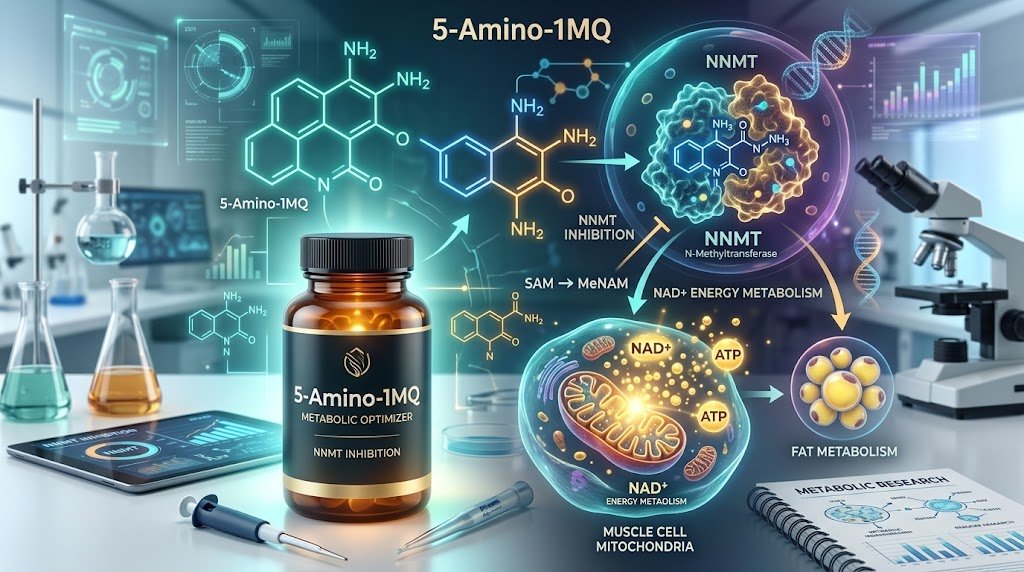
What Is 5-Amino-1MQ? NNMT Inhibition, Dosing Protocols & Evidence
In cellular energetics and anti-aging pharmacology, researchers study 5-amino-1MQ as a targeted small molecule capable of reversing age-related metabolic slowing. By blocking a specific cytosolic enzyme, this compound preserves critical cellular energy cofactors and accelerates fat cell metabolism from the inside out.
Online fitness forums often describe 5-amino-1MQ as a metabolic shortcut that shrinks fat stores while building lean muscle mass without dietary discipline. However, disciplined investigation demands that scientists look deeper. Understanding 5-amino-1MQ requires examining its selective inhibition of nicotinamide N-methyltransferase (NNMT), its impact on intracellular NAD+ pools, and what published preclinical animal models confirm about its biological actions.
Quick Summary: What Is 5-Amino-1MQ at a Glance?
Quick Answer: 5-amino-1MQ (5-amino-1-methylquinolinium) is a cell-permeable small molecule that selectively inhibits nicotinamide N-methyltransferase (NNMT). By halting the conversion of nicotinamide into 1-methylnicotinamide (1-MNA), it funnels nicotinamide into the NAD+ salvage pathway, elevating intracellular NAD+ by 1.2 to 2-fold, activating SIRT1 and PGC-1α mitochondrial biogenesis, and shrinking hypertrophic adipocytes without central nervous stimulation.
| Parameter | Oral Research Protocol | Subcutaneous (Sub-Q) Injectable Protocol |
|---|---|---|
| Primary Focus | Systemic NNMT inhibition, hepatic lipid handling, visceral fat beds | Peripheral subcutaneous fat exposure, rapid muscle bioavailability |
| Typical Evaluation Dose | 50–150 mg per day (split into 1–3 daily administrations) | 5–10 mg per day (administered once daily) |
| Primary Mechanism | Direct hepatic NNMT blockade and cellular NAD+ replenishment | Subcutaneous adipocyte shrinkage and localized SIRT1 activation |
| Direct Research Supply | Lyophilized high-purity research vials available via 5-Amino-1MQ (50mg) | |
What Is 5-Amino-1MQ?
5-amino-1MQ (5-amino-1-methylquinolinium) is a synthetic, membrane-permeable small molecule derivative of quinoline with a low molecular weight of 159.21 g/mol.
Researchers at the University of Texas Medical Branch (UTMB) identified the compound while screening for selective inhibitors of nicotinamide N-methyltransferase (NNMT). NNMT is a metabolic enzyme that resides primarily in adipose tissue and the liver. In mammalian physiology, NNMT acts as a master regulator of energy balance and cellular methylation by transferring a methyl group from S-adenosylmethionine (SAM) onto nicotinamide (NAM), creating 1-methylnicotinamide (1-MNA).
As organisms age, develop obesity, or experience metabolic stress, adipocytes dramatically upregulate NNMT expression. This overactivity burns through precious cellular methylation resources and drains nicotinamide away from the salvage pathway, leaving cells depleted of vital coenzymes. 5-amino-1MQ acts as a potent, cell-permeable competitive inhibitor that halts this enzymatic drain.
Mechanisms of Action: How 5-Amino-1MQ Restructures Cellular Energy
5-amino-1MQ does not interact with surface appetite receptors or mimic adrenergic stimulants. Instead, it alters intracellular substrate availability and enzymatic flux:
1. Preservation of Intracellular NAD+ Concentrations
Cells require nicotinamide adenine dinucleotide (NAD+) to fuel mitochondrial respiration, ATP production, and DNA repair. Under typical metabolic conditions, the NAD+ salvage pathway converts free nicotinamide back into NAD+ through the rate-limiting enzyme NAMPT. By inhibiting NNMT, 5-amino-1MQ stops the conversion of nicotinamide into waste 1-MNA. This blockade preserves intracellular nicotinamide, driving it straight into the salvage pathway and boosting intracellular NAD+ levels by up to 1.2 to 2-fold in stressed adipocytes.
2. Activation of Sirtuin-1 (SIRT1) Signaling
SIRT1 is an essential NAD+-dependent deacetylase that governs mitochondrial biogenesis, fatty acid oxidation, and longevity pathways. High intracellular NAD+ concentrations activate SIRT1 directly. Once stimulated, SIRT1 deacetylates PGC-1α (peroxisome proliferator-activated receptor gamma coactivator 1-alpha), instructing fat and muscle cells to generate fresh mitochondria and consume energy more rapidly.
3. Direct Adipocyte Shrinkage (Anti-Hypertrophy)
In mature fat cells, NNMT overactivity acts as an energetic brake, slowing lipid breakdown and encouraging fat storage. Inhibiting NNMT with 5-amino-1MQ releases this brake. Adipocytes accelerate cellular respiration, burn through stored triglycerides, and downregulate lipid storage genes. Crucially, this pathway shrinks the physical size (hypertrophy) of existing fat cells rather than destroying them, reducing systemic inflammatory adipokine release.
4. Preservation of the SAM/SAH Methylation Ratio
NNMT consumes the universal methyl donor S-adenosylmethionine (SAM), converting it into S-adenosylhomocysteine (SAH). Chronic NNMT overactivation depletes cellular SAM reserves, distorting DNA and histone methylation patterns. By blocking NNMT, 5-amino-1MQ restores the SAM/SAH ratio, maintaining normal epigenetic regulation and cellular methylation balance.
What Does the Research Actually Show?
Evaluating 5-amino-1MQ requires researchers to balance compelling animal data against the current absence of published Phase 3 human trials.
Preclinical Animal Milestones (The UTMB Trials)
Foundational preclinical literature on 5-amino-1MQ comes from rodent studies at UTMB evaluating diet-induced obese mice. The published findings showed striking metabolic shifts:
- Rapid Adiposity Loss: Mice treated with 5-amino-1MQ experienced a 7% reduction in total body weight over just 11 days without altering their daily food intake.
- Adipocyte Remodeling: Treated animals demonstrated a 30% reduction in white adipose tissue volume and a 35% decrease in the cross-sectional size of individual fat cells.
- Blood Lipid & Glycemic Improvements: Total plasma cholesterol dropped by 30%, while systemic insulin sensitivity and glucose clearance improved significantly.
- Absence of Central Nervous System Effects: The compound caused no changes in appetite, heart rate, or blood pressure, confirming that its actions occur at the tissue level rather than through sympathetic nervous stimulation.
The Clinical Trial Gap
While veterinary and rodent studies document profound metabolic improvements, researchers have not yet concluded formal, double-blind, placebo-controlled Phase 3 human trials on pure 5-amino-1MQ. Outside preclinical research, data stems from observational wellness tracking and off-label compounding rather than formal FDA-approved clinical filings.
Regulatory Standing
5-amino-1MQ is an unapproved investigational chemical designated strictly for in-vitro laboratory analysis, molecular research, and animal studies. Neither Health Canada nor the US FDA has approved the compound for human medical treatment, disease prevention, or athletic supplementation.
Documented Laboratory Research & Dosing Protocols
Published literature, laboratory investigations, and observational metabolic models apply the following parameters across oral and subcutaneous injectable routes. Dilution volumes can be mapped instantly with our free Peptide Calculator and recorded within the Protocol Tracker Tool.
| Parameter | Oral Research Protocol | Subcutaneous (Sub-Q) Injectable Protocol |
|---|---|---|
| Experimental Focus | Systemic NNMT inhibition, hepatic lipid handling, gut-first absorption | Direct systemic bioavailability, localized subcutaneous adipose exposure |
| Documented Dosing | 50–150 mg per day (split into 1–3 daily doses) | 5–10 mg per day (administered once daily) |
| Administration Route | Oral capsule or solution (taken alongside meals) | Subcutaneous (Sub-Q) injection into abdominal fat depots |
| Timing Window | Morning or distributed evenly with balanced meals | Morning in a fasted state or immediately prior to physical activity |
| Cycle Duration | 8–12 weeks continuous evaluation (review our Peptide Cycle Timing Guide) | 4–8 weeks continuous evaluation |
| Washout Window | 4–6 weeks off between experimental cycles | 4 weeks off between experimental cycles |
| Screening Panels | CMP, lipid profile, fasting glucose, liver enzymes (ALT/AST) | CMP, fasting insulin, HbA1c, baseline injection-site tolerability |
Comparing Administration Routes: Oral vs. Subcutaneous (Sub-Q)
Researchers select administration routes based on specific pharmacological targets:
- Oral Administration (50–150 mg/day): Due to first-pass hepatic metabolism, oral delivery directly targets liver tissue and visceral fat beds, making it ideal for studying systemic metabolic syndrome and hepatic lipid clearance.
- Subcutaneous Injection (5–10 mg/day): Injectable administration bypasses first-pass gastrointestinal metabolism completely, achieving higher peak plasma concentrations at roughly one-tenth of the oral dose. Researchers use Sub-Q protocols to focus on peripheral subcutaneous fat reduction and rapid muscle tissue bioavailability.
Synergistic Research Pairings
Researchers frequently combine 5-amino-1MQ with complementary peptides to evaluate multi-target metabolic and cellular pathways:
- MOTS-c: Scientists study 5-amino-1MQ alongside MOTS-c (or examine MOTS-c 10mg/40mg) to analyze simultaneous intracellular NAD+ preservation and direct mitochondrial AMPK activation.
- AOD-9604: Research teams pair 5-amino-1MQ with AOD-9604 Peptide to evaluate how selective NNMT inhibition interacts with beta-3 adrenergic receptor lipolysis.
- Retatrutide: Laboratories cross-reference oral NNMT blockade with the triple-agonist incretin action of Retatrutide (or view Retatrutide vials) to assess body composition shifts while preserving muscle mass.
- Tirzepatide: Investigators evaluate dual incretin appetite suppression through Tirzepatide alongside peripheral adipose remodeling with 5-amino-1MQ.
- BPC-157: Researchers pair metabolic protocols with BPC-157 to maintain gastrointestinal mucosal integrity during rapid body composition changes.
Laboratory Handling, Reconstitution & Storage Standards
Proper laboratory storage ensures consistent potency and chemical stability across both solid and liquid forms (detailed step-by-step in our Beginner's Guide to Peptides):
- Dry Powder & Capsules: Store analytical-grade 5-amino-1MQ powder or raw capsules in a cool, dry environment away from direct sunlight at controlled room temperature (15°C to 25°C). For long-term preservation, seal raw powder containers tightly at -20°C.
- Sub-Q Reconstitution Protocol: When reconstituting lyophilized injectable vials, use sterile, pharmaceutical-grade Pfizer Hospira Bacteriostatic Water or 0.9% Sterile Bacteriostatic Saline. Introduce the diluent gently down the inside glass wall with a sterile EasyTouch 31G Syringe. Roll the vial between your palms until the solution dissolves completely.
- Reconstituted Liquid Storage: Maintain dissolved injectable solutions refrigerated between 2°C and 8°C (36°F to 46°F) inside a secure, light-shielded Peptide Vial Case or insulated Compact Travel Case to protect against light exposure and degradation.
5-amino-1MQ represents an innovative approach to metabolic and longevity research. By selectively blocking NNMT, it preserves the cellular NAD+ pool, activates SIRT1, and shrinks hypertrophic fat cells without stimulating the central nervous system. Researchers who respect structured oral and subcutaneous dosing protocols, track regular metabolic blood panels, and maintain proper chemical storage will ensure accurate, reproducible experimental results.
← View all peptide guides, research & protocols in our Blog Archive


6 comments