
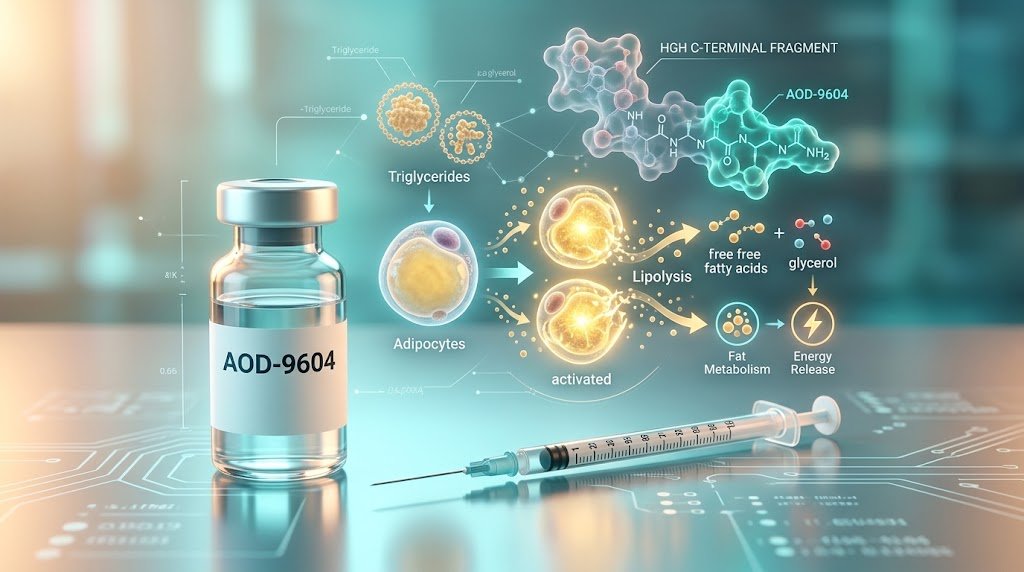
What Is AOD-9604? hGH Fragment 177-191 Mechanisms & Dosing
In metabolic biochemistry, researchers study AOD-9604 as a targeted peptide fragment designed to replicate the fat-mobilizing effects of human growth hormone without triggering its proliferative or diabetogenic side effects.
Online fitness forums often describe AOD-9604 as a side-effect-free fat burner that melts subcutaneous adipose deposits without dietary discipline. However, disciplined scientific evaluation requires researchers to examine the exact molecular modifications of the molecule, its beta-3 adrenergic pathways, and what published human clinical trials confirm regarding its real-world efficacy.
Quick Summary: What Is AOD-9604 at a Glance?
Quick Answer: AOD-9604 is a synthetic 16-amino-acid peptide derived from the C-terminal lipolytic domain of human growth hormone (hGH residues 177–191) with an added tyrosine residue and a cyclic disulfide bridge. It activates beta-3 adrenergic receptors to drive hormone-sensitive lipase (HSL) lipolysis and inhibit de novo lipogenesis without binding liver growth hormone receptors or stimulating IGF-1.
| Parameter | Subcutaneous Fat-Loss Protocol | Intra-Articular Joint Repair Protocol |
|---|---|---|
| Primary Focus | Lipolytic signaling, adipose reduction, metabolic evaluation | Chondrocyte regeneration, joint lubrication, cartilage repair |
| Typical Evaluation Dose | 300–500 mcg per day (administered once daily) | 500 mcg–1 mg co-administered with hyaluronic acid |
| Administration Route | Subcutaneous (Sub-Q); strictly in a fasted state | Intra-articular localized joint injection |
| Direct Research Supply | Lyophilized high-purity research vials available via AOD-9604 (5mg) | |
What Is AOD-9604?
AOD-9604 (Advanced Obesity Drug-9604) is a synthetic 16-amino-acid peptide with a molecular weight of approximately 1,815 Daltons.
Developed originally by Professor Frank Ng and researchers at Monash University in Australia during the late 1990s, AOD-9604 represents a modified terminal fragment of human growth hormone (hGH fragment 176-191). Researchers identified that the extreme C-terminal region of native hGH (residues 177–191) directs the hormone's lipolytic (fat-burning) actions, completely independent of the N-terminal regions that drive growth stimulation and cellular proliferation.
To enhance chemical stability, biochemists added an extra tyrosine residue at the N-terminus and engineered an internal disulfide bridge between cysteine residues 182 and 189. This cyclic stabilization protects the peptide against rapid enzymatic degradation, preserving its biological conformation in research models.
Mechanisms of Action: How AOD-9604 Directs Adipocyte Metabolism
Full-length growth hormone exhibits dual actions: it drives growth factor expression and simultaneously mobilizes lipid stores. AOD-9604 isolates fat metabolism while avoiding somatogenic pathways:
1. Upregulation of Lipolysis via Beta-3 Adrenergic Receptors
AOD-9604 binds selectively to beta-3 adrenergic receptors on adipocyte membranes. This binding event elevates intracellular cyclic adenosine monophosphate (cAMP), activating protein kinase A (PKA). PKA then phosphorylates hormone-sensitive lipase (HSL) and perilipin, freeing triglycerides stored within fat droplets and breaking them down into glycerol and free fatty acids for metabolic oxidation.
2. Direct Inhibition of Lipogenesis
Beyond breaking down existing adipose stores, AOD-9604 actively suppresses the pathways that create new fat. In cell cultures, the peptide reduces the activity of acetyl-CoA carboxylase and glycerol-3-phosphate dehydrogenase—two rate-limiting enzymes required for de novo lipogenesis. This dual action starves fat cells of the biochemical machinery needed to rebuild triglyceride reserves.
3. Independence from the IGF-1 Axis
The critical pharmacological advantage of AOD-9604 lies in what it does not do. Unlike native hGH, AOD-9604 does not bind to the systemic growth hormone receptor (GHR) in the liver. Consequently, it does not stimulate circulating Insulin-Like Growth Factor 1 (IGF-1) release. This independence eliminates risks associated with full-length GH therapy, such as insulin resistance, hyperglycemia, acromegaly, and accelerated tumor cell proliferation.
4. Secondary Chondrogenic & Cartilage Repair Mechanisms
Emerging regenerative orthopaedic research reveals that AOD-9604 also displays chondrogenic activity. In laboratory joint models, the peptide enhances proteoglycan and Type II collagen synthesis in chondrocytes. When researchers co-administer it with hyaluronic acid in animal models of osteoarthritis, AOD-9604 significantly accelerates cartilage matrix restoration and limits joint degradation.
What Does the Clinical Research Actually Show?
AOD-9604 underwent extensive pharmaceutical clinical trials in the early 2000s under Metabolic Pharmaceuticals, yielding a clear safety profile alongside mixed metabolic endpoints.
Clinical Trial Milestones (Phases 1 and 2)
The developer evaluated oral and injectable AOD-9604 in six randomized, double-blind, placebo-controlled clinical trials involving over 900 human subjects:
- Safety and Glycemic Stability: The trials confirmed remarkable tolerability. Unlike full hGH, AOD-9604 induced no changes in blood glucose levels, insulin sensitivity, or circulating IGF-1 concentrations, demonstrating a favorable systemic safety profile.
- Weight Loss Endpoints: An early Phase 2b trial showed modest but statistically significant weight loss (around 2.6 kg over 12 weeks) at a 1 mg oral daily dose. However, a subsequent 24-week Phase 2b trial failed to achieve primary weight loss targets across a broader cohort, leading the original pharmaceutical sponsor to halt commercial obesity development.
Regulatory Standing
The US FDA designated AOD-9604 as Generally Recognized as Safe (GRAS) for specific food additive applications up to 1 mg/day in 2014. However, neither the US FDA nor Health Canada has approved AOD-9604 as an injectable pharmaceutical drug for weight loss. Furthermore, the World Anti-Doping Agency (WADA) strictly prohibits AOD-9604 under Section S0 (Non-Approved Substances).
Documented Laboratory Research & Dosing Protocols
Within published preclinical literature, clinical trials, and observational research models, experimental investigations utilize the following parameters. When structuring research cycles, investigators map syringe increments with our free Peptide Calculator and manage multi-week intervals inside the Protocol Tracker Tool.
| Parameter | Subcutaneous Fat-Loss Protocol | Intra-Articular Joint Repair Protocol |
|---|---|---|
| Experimental Focus | Lipolytic signaling, adipose reduction, metabolic evaluation | Chondrocyte regeneration, joint lubrication, cartilage repair |
| Documented Dosing | 300–500 mcg per day (administered once daily) | 500 mcg–1 mg paired with hyaluronic acid |
| Administration Route | Subcutaneous (Sub-Q) injection into abdominal fat | Intra-articular localized joint injection |
| Timing Window | Strictly fasted state (morning upon waking or before sleep) | Periodic localized administration (clinical setting) |
| Cycle Duration | 8–12 weeks of continuous evaluation (see our Peptide Cycle Timing Guide) | 2–4 weeks continuous evaluation |
| Washout Window | 4 weeks off between experimental cycles | 4–8 weeks off between cycles |
| Screening Panels | Fasting blood glucose, fasting insulin, comprehensive lipid profile | Localized joint imaging, inflammatory markers (CRP) |
The Critical Need for Fasted Administration
Because AOD-9604 operates through hormone-sensitive lipase, ambient insulin concentrations dictate its efficacy. Circulating insulin acts as a potent inhibitor of lipolysis. If researchers administer AOD-9604 following a carbohydrate-rich meal, insulin suppresses HSL activation, blunting the peptide's fat-clearing signaling. Laboratory protocols maintain a strict 2-to-3-hour fasted window before and after administration to maximize lipolytic response.
Synergistic Research Pairings
Investigators frequently cross-reference AOD-9604 with complementary metabolic and regenerative compounds:
- MOTS-c: Scientists study AOD-9604 alongside MOTS-c (or view MOTS-c 10mg/40mg) to observe simultaneous adipocyte lipolysis and muscle AMPK-mediated fatty acid oxidation.
- 5-Amino-1MQ: Researchers evaluate adipose tissue shifts by combining AOD-9604 with 5-Amino-1MQ to investigate combined lipolytic signaling and cellular NNMT inhibition.
- BPC-157: In orthopaedic joint models, researchers pair AOD-9604 with BPC-157 to analyze concurrent chondrocyte regeneration and VEGFR2 microvascular repair.
- Wolverine Blend: Teams cross-reference joint recovery markers against the Wolverine Blend (BPC-157 / TB-500) (available as pre-mixed Wolverine Blend vials) during complex musculoskeletal studies.
- Tesamorelin: Evaluated alongside GHRH secretagogues in our Tesamorelin Research Guide to study targeted visceral adipose clearance.
Laboratory Handling, Reconstitution & Storage Standards
To preserve the disulfide bridge and conformational integrity of this 16-amino-acid peptide during multi-week protocols, researchers follow rigorous handling procedures (outlined in our Beginner's Guide to Peptides):
- Diluent Selection: Reconstitute lyophilized AOD-9604 using sterile, pharmaceutical-grade Pfizer Hospira Bacteriostatic Water containing 0.9% benzyl alcohol to prevent microbial growth across repeated withdrawals. Alternatively, use 0.9% Sterile Bacteriostatic Saline for cell-culture and joint-injection models.
- Reconstitution Protocol: Use a sterile EasyTouch 31G Syringe to introduce the diluent slowly down the inside glass wall of the vial. Never spray liquid directly onto the lyophilized cake. Avoid shaking or vortexing; roll the vial slowly between your palms until the powder fully dissolves into a clear liquid.
- Cold-Chain Storage: Store dry lyophilized vials at -20°C for long-term molecular stability. Maintain reconstituted liquid solutions between 2°C and 8°C (36°F to 46°F) inside a secure, light-shielded Peptide Vial Case or insulated Compact Travel Case to protect against mechanical agitation and photo-oxidation.
AOD-9604 remains a valuable molecular template for studying isolated lipolytic pathways. By isolating the fat-mobilizing C-terminal sequence of human growth hormone while bypassing hepatic IGF-1 activation, it avoids the systemic proliferative and glycemic side effects of full hGH. Ensuring fasted administration windows, verifying peptide purity through independent third-party testing, and adhering to strict cold-chain preparation will ensure accurate, reproducible experimental results.
← View all peptide guides, research & protocols in our Blog Archive


6 comments