What Is a Peptide? Everyday Analogies & Laboratory Guide
Biochemistry textbooks love dense terminology, but understanding peptides does not require a medical degree. When you strip away the Latin prefixes, your body functions much like a massive company running on real-time messages.
In this cellular corporation, your organs act like specialized departments. However, these departments cannot function in isolation. They need reliable messengers to deliver precise memos telling them when to repair damaged walls, burn stored inventory, or shut down security alarms. Peptides represent those exact memos. This guide explains peptide science through intuitive everyday comparisons, breaking down what they are, how they differ from whole proteins, and how researchers classify them in the laboratory.
Quick Summary: What Is a Peptide at a Glance?
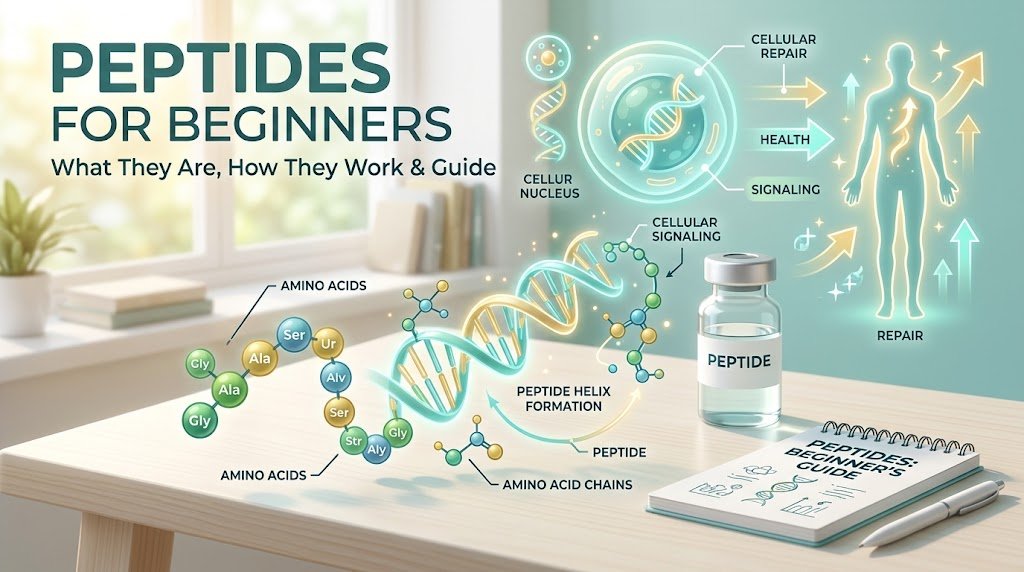
Quick Answer: A peptide is a short chain of 2 to 50 amino acids linked together by chemical peptide bonds. While proteins are large, complex molecules that provide structural mass or act as enzymes, peptides function primarily as biological signaling messengers—binding to cell receptors to turn specific cellular processes on or off.
| Feature | Peptide Molecule | Protein Molecule |
|---|---|---|
| Chain Length | 2 to 50 amino acids | 50+ to several thousand amino acids |
| Primary Function | Signaling messenger, receptor ligand, transcription trigger | Structural tissue, physical scaffolding, enzymatic machinery |
| Everyday Analogy | The blueprint memo or foreman's walkie-talkie | The physical brick wall, timber, or construction crane |
| Research Supply Example | BPC-157 (15 amino acids) | Native Collagen / Albumin / Myosin complexes |
The Alphabet Analogy: What Is a Peptide?
To understand peptides, picture a language constructed from just 20 letters:
- Amino Acids (The Letters): The 20 dietary amino acids act as individual alphabet blocks. Standing alone, a single letter like "R" or "A" carries limited practical meaning.
- Peptides (The Words & Short Sentences): Stringing a few letters together creates meaningful words. Linking two, three, or fifteen amino acids forms a peptide. That specific sequence spells out a functional message for your cells. For example, KPV Peptide strings together just three letters (Lysine-Proline-Valine) to spell a targeted "calm inflammation" memo.
- Proteins (The Full Encyclopedias): Assembling hundreds of words into complex chapters creates a complete book. Any chain exceeding 50 amino acids becomes a protein.
The House Analogy: Peptides vs. Proteins
Because proteins and peptides share the same amino acid building blocks, newcomers often mix them up. Think of a house under construction:
- Proteins Are the Brick Walls & Heavy Machinery: Large proteins (like collagen lattices, muscle actin, or digestive enzymes) serve as the physical timber, bricks, and cranes on a construction site. They provide physical mass and perform heavy lifting. Because of their sheer size, you cannot slip a whole brick wall through a keyhole.
- Peptides Are the Blueprints & Walkie-Talkies: Peptides possess virtually no structural weight. Instead, they act like the foreman's walkie-talkie transmitting precise instructions. A tiny 15-amino-acid peptide like BPC-157 tells the construction crew where to lay down fresh plumbing (new blood vessels) without becoming the pipe itself.
How Do Peptides Work? The Lock, Key & Dispatcher
Peptides direct cellular operations through clear mechanical pathways:
1. The Lock and Key (Cell Surface Receptors)
Every cell wraps itself in a protective wall studded with microscopic keyholes called receptors. Peptides fold into specific three-dimensional keys. A metabolic peptide like Semaglutide glides through circulation until it encounters its matching GLP-1 receptor lock. Inserting the key triggers an internal cascade: the cell immediately turns down hunger signaling and releases insulin without the peptide ever setting foot inside the room.
2. The Specialized Courier (Direct Nuclear Influx)
Certain ultra-small peptides do not stay outside the door. Carrier proteins (like the PepT1 transporter in the gut) recognize short peptides like KPV and escort them through the cell entrance. The peptide walks straight into headquarters (the nucleus) and physically holds down the master alarm button (NF-κB) to silence inflammatory alarms at the source.
3. The Physical Needle (Antimicrobial Action)
Host-defense peptides like LL-37 do not bother with locks or couriers. Carrying a positive static charge, they gravitate toward the negative charge on bacterial outer walls like opposite poles of a magnet. Once attached, they act like molecular needles, punching physical holes into the microbe's outer membrane so it lyses within minutes.
The Software Update: Peptide Bioregulators
Standard peptides operate like text alerts: they deliver an immediate instruction to a surface receptor and fade away. However, peptide bioregulators function more like direct operating system updates.
Discovered through decades of research by Professor Vladimir Khavinson, bioregulators are ultra-short sequences containing just two to four amino acids.
Because they are so small, bioregulators stroll straight past cell security gates and enter the central vault where your DNA library sits. Aging or stressed cells often let their DNA scrolls get tangled and dusty (heterochromatin compaction), leaving critical repair manuals unreadable. Bioregulators slip directly between the grooves of the DNA spiral like a bookmark, gently untangling the strands. This contact allows the cell to re-read its original genetic blueprints, reactivating dormant cellular repair and normalizing organ function.
Bioregulators display strict tissue targeting:
- Pineal Bioregulators (Epithalon): A four-amino-acid bookmark (Ala-Glu-Asp-Gly) that targets the brain's circadian master clock, prompting pineal cells to restore youthful melatonin rhythms and activate telomerase. Learn more in our Epithalon Protocol Guide.
- Vascular Bioregulators (Vesugen): A three-letter code that slips into blood vessel lining cells, instructing them to rebuild flexible, elastic arterial walls.
- Thymus Bioregulators (Vilon): Short amino acid pairs that visit immune command centers to reboot balanced white blood cell production.
Primary Categories of Research Peptides
Researchers classify peptides into functional departments based on the tasks they coordinate:
| Department Category | Everyday Analogy Role | Representative Compounds & Guides |
|---|---|---|
| Peptide Bioregulators | Software updates that untangle and re-read dormant DNA blueprints | Epithalon, Vesugen, Pinealon, Vilon |
| Tissue Repair & Angiogenesis | Emergency dispatchers routing new plumbing and scaffolding to damage sites | BPC-157, TB-500, Wolverine Blend |
| Extracellular Remodeling | Architects reorganizing collagen framework and clearing scar debris | GHK-Cu Copper Tripeptide, GHK Basic |
| Immune Defense & Barriers | Tactical security guards patching border fences and popping microbes | LL-37, KPV Peptide |
| Metabolic Incretins | Fuel gauges signaling satisfaction and pacing gastric engine speed | Semaglutide, Tirzepatide, Retatrutide |
| Cellular Energy & Lipolysis | Factory efficiency managers burning backstocked warehouse fat | MOTS-c, AOD-9604, 5-Amino-1MQ |
| Growth Hormone Secretagogues | Nighttime supervisors signaling the master gland to release repair pulses | Ipamorelin / CJC-1295, Sermorelin, Tesamorelin |
The Paper Shredder: Why Most Peptides Cannot Be Swallowed
Beginners often wonder why researchers inject tiny peptide solutions instead of simply swallowing a convenient pill.
Your stomach functions like an industrial paper shredder. Its primary duty is breaking down whole proteins (like steak or eggs) into loose amino acid building blocks for energy. When you swallow a delicate, meaningful peptide memo, powerful stomach acid and digestive enzymes (proteases) shred that sequence into unreadable letters within seconds.
While researchers study specific small molecules and durable fragments (such as 5-amino-1MQ or oral KPV) for direct gut absorption, systemic investigations rely on subcutaneous (Sub-Q) delivery. Injecting into the fatty layer directly beneath the skin completely bypasses the stomach's shredder. The intact memo enters the local capillary river undamaged, traveling smoothly toward its target department. (Learn more about absorption routes in our comparison of Sub-Q vs. IM vs. Nasal Peptide Delivery).
Laboratory Fundamentals: Reconstitution & Cold Storage
Because wet peptide bonds spoil quickly at room temperature, laboratories prepare compounds in suspended animation as a freeze-dried cake known as a lyophilized powder. Preparing these molecules requires simple, disciplined precision (detailed step-by-step in our comprehensive Beginner's Guide to Your First Peptide):
- Adding the Liquid: Mix lyophilized vials using pharmaceutical-grade Pfizer Hospira Bacteriostatic Water containing 0.9% benzyl alcohol. This agent acts like a preservative shield, keeping the water sterile for multiple withdrawals over a multi-week protocol. Alternatively, use 0.9% Sterile Bacteriostatic Saline for cell-culture targets.
- Treating the Solution Carefully: Use a sterile EasyTouch 31G Syringe to let the liquid slide gently down the inner glass wall. Never shoot liquid directly at the delicate powder cake. Avoid violent shaking; roll the vial gently between your palms like a fine vintage wine until the solution clears completely.
- Calculating Precise Units: Avoid syringe math errors by utilizing our interactive Peptide Reconstitution Calculator and organizing multi-week cycles with the Protocol Tracker Tool.
- Respecting the Cold Chain: Keep dry powder vials frozen at -20°C for long-term preservation. Once reconstituted into liquid form, store the active solution inside a refrigerator between 2°C and 8°C (36°F to 46°F) sheltered inside a cushioned, light-blocking Peptide Vial Case or insulated Compact Travel Case to protect against light exposure and vibrations.
Peptides are simply the natural language your body speaks every day. Whether acting as biological memos that dispatch tissue repair, keys that regulate metabolic fuel, or epigenetic updates that uncoil aging DNA blueprints, they deliver instructions with molecular precision. Understanding these everyday comparisons, verifying sequence purity through third-party testing, and adhering to careful laboratory handling will ensure your scientific research remains reliable and reproducible.
← View all peptide guides, research & protocols in our Blog Archive